
Introduction
India is the world’s largest producer of legumes/pulses. The pulses grown in India include Bengal gram, also known as chickpeas (Chana in Hindi). Processed chickpeas/Chana has a wide application in India and parts of the world. And, roasted Chana is a popular and healthy snack food made from chickpeas/Chana.
Have you ever wondered ‘How roasted Chana is made? This article discusses the ‘Roasted Chana manufacturing process’ in detail.
Chickpeas have their own names in Indian languages and some of them are:
- Kadale Kalu in Kannada
- Shanagalu in Telugu
- Konda Kadalai in Tamil
- Vellakadal in Malayalam
- Chane in Marathi
- Chana in Hindi, Gujarati, and Punjabi
I will use the name Chana in this article since it is understood by many people.
What is roasted Chana?
Even though Chana converted to Chana dal has huge demand, other versions of Chana are also popular. Examples are roasted Chana is a popular snack, and Chana flour (besan) is used for preparing Indian snacks and sweets.
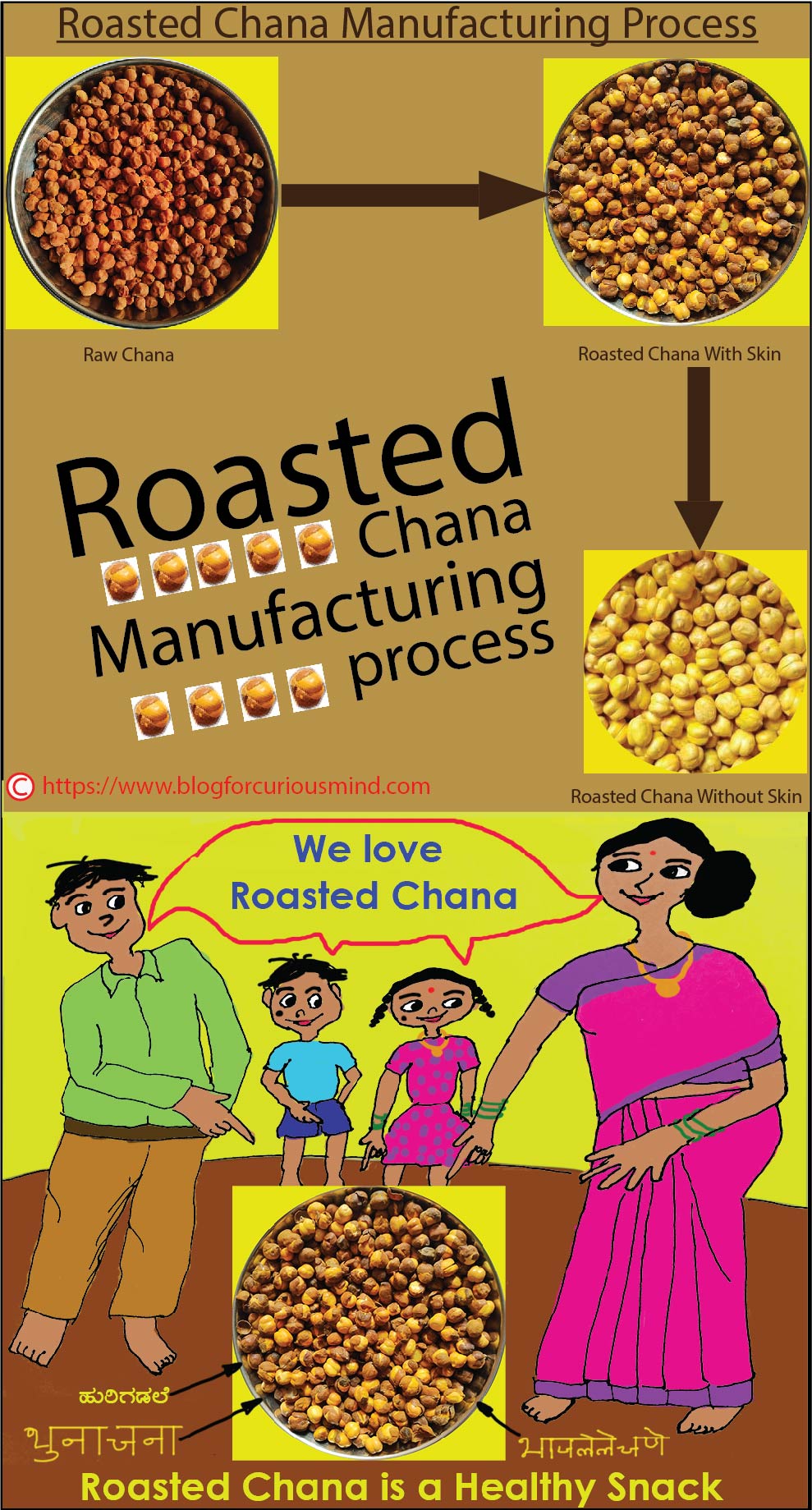
Roasted Chana is a traditional and nutritious legume snack in India. Roasted Chana is popularly known as ‘Phutana or Bhuna Chana’ in Hindi, ‘Pottukadalai’ in Tamil, Bhajlele Chane in Marathi, and ‘Hurigadale’ in Kannada.
Roasted Chana is prepared by soaking clean Chana in water followed by drying and roasting in hot sand. This process converts the hard Chana into a soft, crisp, and crunchy snack. Roasting is done in hot sand maintained at 200 to 300⁰ ° centigrade.
During roasting, the Chana swells, becomes soft, and roasting makes it crisp. Roasting makes the Chana swell and pop out. The low moisture content of roasted Chana enhances its shelf life. Properly packed roasted Chana can be stored for up to six months.
Roasted Chana can be of two types:
- Roasted Chana without skin (dehulled) and
- Roasted Chana with skin.
A diverse variety of roasted Chana can be prepared by adding salt, chili powder, and other spices during the last stages of manufacturing.
Roasted Chana Manufacturing Process
It is important to select good-quality Chana for making roasted Chana. The selected Chana seeds should be round and large in size, light-colored, and with a smooth surface. The hull (outer skin) should be thick and easily removable during processing.
Even though the consumption of Chana in our country dates back to more than 200 years, not much research has been done by our forefathers on this. Due to this, the manufacturing process of roasted Chana may slightly differ from place to place and unit to unit.
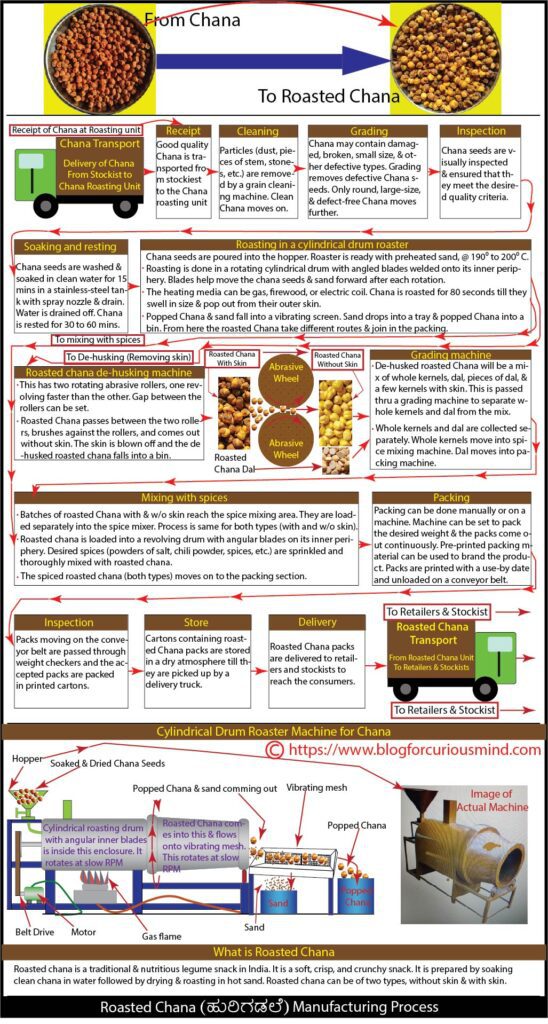
Steps in the roasted Chana manufacturing process:
- Cleaning
- Grading
- Inspection
- Soaking and resting
- Roasting in a cylindrical drum roaster
- Roasted Chana de-husking machine
- Grading machine
- Mixing with spices
- Packing
- Inspection
- Store
- Delivery
I will discuss the above steps in the following paragraphs.
Cleaning
The Chana may have foreign particles like dust, pieces of stem, stones, etc. These are removed by passing the Chana through a grain cleaning machine. This machine removes the foreign particles and gives a clean Chana. This machine has vibrating screens, magnetic separators, and de-stoners.
Grading
The Chana bought from the market may contain damaged, broken, small sizes, and other defective types. During grading, the defective Chana seeds are removed through screening. Only round, large-sized, and defect-free Chana seeds are allowed to move into the next process. The grading process includes round and size screeners.
Inspection
The Chana seeds are visually inspected and ensured that they meet the desired quality criteria.
Soaking and resting
Soaking is a crucial step in the manufacturing of roasted Chana. It is important that the Chana seeds have the desired moisture in them for proper popping when come in contact with hot sand.
Chana seeds are washed and soaked in clean water for around 15 minutes. Soaking is done in a stainless-steel tank with a spray nozzle and drain arrangement. The water is drained off. The Chana seeds are allowed to rest for 30 minutes to one hour.
Roasting in a cylindrical drum roaster
The Chana seeds are poured into the hopper of the cylindrical drum roaster. The roaster is made ready with preheated sand, and the sand temperature is 190⁰ to 200⁰ centigrade. The Chana seeds are allowed to flow into the roasting drum in a regulated manner.
The roasting is done in a rotating cylindrical drum that has angled blades welded onto its inner periphery. The material of construction can be stainless steel in high-end machines. The angular blades help move the Chana seeds and sand forward after each rotation.
The roasting drum rotates at a slow rpm and is continuously heated by a heating medium. The heating media can be gas, firewood, or an electric coil.
The Chana seeds are roasted for around 80 seconds till they swell in size (expand) and pop out from their outer skin.
The popped Chana seeds and sand exit the roaster and fall into a vibrating screen. The vibrating screen drops the sand into a tray kept below and pushes the popped Chana seeds into a collecting bin.
From here, the roasted Chana seeds take different routes and join in the packing section.
- First route: Roasted Chana seeds with skin can go to the spice mixing machine and then to the packing machine.
- Second route: Alternately, the roasted Chana seeds go into a de-husking machine where the outer husk (skin) is removed. It is then graded and moved for spicing and packing.
This and this YouTube videos shows the working of the Chana roasting machine (Hindi)
Roasted Chana de-husking machine
To meet the demand for roasted Chana without skin, part of the daily production is de-husked in a Chana de-husking machine.
This machine consists of two rotating abrasive rollers. One roller revolves faster than the other, and the gap between the rollers can be set as required.
The roasted Chana passes between the two rollers, brushes against the rollers, and comes out without skin. The skin is blown off, and the de-husked roasted Chana falls into a bin.
This YouTube video shows the working of a roasted chana de-husking machine.
Grading machine
The de-husked roasted Chana will be a mix of whole kernels, dal, pieces of dal, and a few kernels with skin. This mix is passed through a grading machine. This machine has different sizes of sieves and separates the whole kernels and dal from the mix.
The whole kernels and dal are collected separately. The whole kernels move into the spice mixing machine. The dal moves into the packing machine.
Note: The de-husking machine and grading machines can be used for converting the whole batch of roasted Chana into roasted Chana dal.
Mixing with spices
Batches of roasted Chana with skin and without skin reach the spice mixing area. They are loaded separately into the spice mixer. The process is the same for both types of roasted Chana (with and without skin).
Roasted Chana is loaded into a revolving drum with angular blades on its inner periphery. The desired spices (powders of salt, chili powder, spices, etc.) are sprinkled and thoroughly mixed with roasted Chana.
The spiced roasted Chana moves on to the packing section.
Packing
Packing can be done manually or on a machine. The machine does the job of filling the correct weight and sealing the packs. The machine can be set to pack the desired weight and the packs come out continuously. Pre-printed packing material can be used to brand the product. The packs are printed with a use-by date and unloaded on a conveyor belt.
Inspection
Packs moving on the conveyor belt are passed through weight checkers and the accepted packs are packed in printed cartons.
Store
Cartons containing roasted Chana packs are stored in a dry atmosphere till they are picked up by a delivery truck.
Delivery
Roasted Chana packs are delivered to retailers and stockists to reach the consumers.
This YouTube video explains the process of making masala Chana. This YouTube video shows the traditional method of roasting Chana. This YouTube video shows the complete process of making roasted Chana.
Making roasted Chana at home
Yes! You can do roasted Chana at home by roasting soaked and dried Chana in hot powder salt. Use a thick, concave griddle (kadai) for roasting. The following YouTube videos will guide you. Video 1 (Kannada) and Video 2 (Marathi).
Chana growing states in India
Major Chana-growing states are Madhya Pradesh, Rajasthan, Telangana, and Maharashtra. It is also grown in Karnataka, Uttar Pradesh, Chhattisgarh, Gujarat, Haryana, and Bihar.
Conclusion
Roasted Chana is an economical, healthy, and tasty snack for children and adults alike. It is much better and healthier than processed and branded snacks available in the market.
Hope this article is able to answer some of your questions on roasted Chana.
You may want to read the following articles:
Health Benefits of Eating Roasted Chana
What is Sabudana and how it is made in India
How Poha is made from rice (paddy)
Nutrients and Vitamins in Cornflakes
How Murmura or Puffed Rice is made from Rice
How Rice is Grown and Harvested in India
How Ragi Huri Hittu or Popped Ragi Powder is Made
Edits with supporting documents are welcome.